
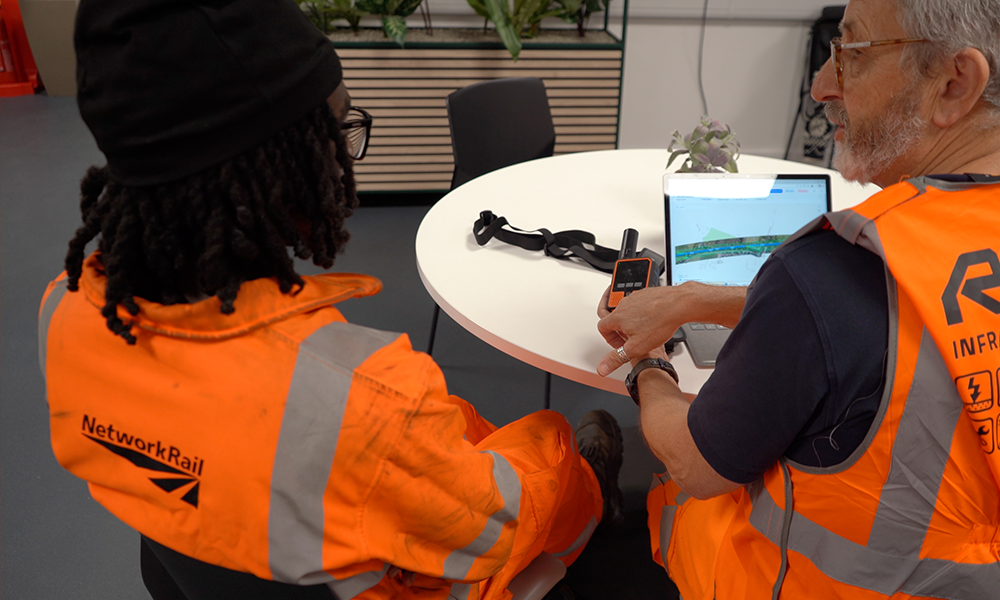



As geofencing continues to become widely adopted for railway project management, Network Rail Anglia has joined a growing list of Network Rail routes and principal contractors using Tended's technology across the network.
Starting with an initial trial, Network Rail Anglia is implementing geofencing across worksites in Ipswich, taking a significant step toward modernising how safety and efficiency are managed during its essential railway upgrade and maintenance projects.
What this means for Network Rail Anglia’s teams
Geofencing works by creating virtual boundaries around safe working areas and attaching small devices to workers' PPE which alert the moment a geofence boundary is crossed. This helps workers maintain safe distances from hazards such as open lines, mitigating loss of situational awareness during demanding shifts. Devices are also attached to plant and equipment onsite to verify locations and enhance safety.
Devices attached to plant and machinery give the Engineering Supervisor (ES) a live view of asset movement across the worksite, allowing them to respond quickly if any unsafe events are identified or any vehicles exit the worksite.
The technology also supports crucial operational processes that have historically been carried out using diagrams and radio communication, susceptible to human error. Protection equipment placement and removal can be verified in real time, and the Line Clear Verification (LCV) process is enhanced by a live view of all assets and equipment onsite, reducing the need for manual checks and lowering the risk of objects being left on the line.
Beyond safety, the reduction in manual processes and verification brings operational efficiencies that have a measurable impact on time and cost across projects.
Virtual Worksite Marker Boards
In addition, Network Rail Anglia will also trial Tended’s Virtual Worksite Marker Boards (VWSMBs) system, which has been approved by the RSSB for on-track plant (OTP) only possessions.
This particular application of geofencing allows organisations to create virtual worksite boundaries, eliminating the need to physically place worksite marker boards on the infrastructure. A in-cab device then uses real-time geospatial data to monitor the plant’s live position, and should it travel within 100m of the worksite limit and cross the defined geofence boundary, the operator is notified immediately through a visual and audible alert.
VWSMBs have already demonstrated substantial benefits to railway projects, as seen by early adopters Siemens Mobility as well as during recent trials with Network Rail Scotland and SPL Powerlines Scotland.
This use of Tended’s system helps address some of the long-standing challenges that come with physical marker boards, such as boards being placed incorrectly, not removed after a shift, or the potentially unsafe conditions for workers accessing the infrastructure to place them . Worksites can also be started faster, making better use of limited possession windows and allowing teams to focus more time on engineering works.
Geofencing continues to accelerate across the railway industry
This deployment marks yet another milestone in what has become an industry-wide shift in how organisations are approaching the safety of their workforce. Across the UK and beyond, Network Rail regions, routes and principal contractors have been adopting geofencing, and Network Rail Anglia's deployment is the latest in a series of recent implementations across the network.
By improving situational awareness, reducing reliance on manual processes, and enhancing the management of worksites, Tended’s system not only strengthens project safety but also delivers measurable operational efficiencies.
This aligns closely with the objectives of CP7, where Network Rail is placing greater emphasis on safety, efficiency, digital systems, and improved asset management across the network. The adoption of systems such as Tended’s geofencing system highlights how emerging technologies can support CP7 ambitions by creating a safer and more reliable railway for both workers and passengers.


