



Working on or near the railway has always carried inherent risk. Moving trains, high-voltage overhead lines, visibility limitations, and the pressure of tight possession windows mean that track workers operate in one of the most demanding safety environments of any industry.
Much advancement has been made over the years, notably the introduction of Network Rail’s Safety Task Force which has been instrumental in removing unassisted lookout working, while also championing new safety systems and technologies across the UK’s rail Network.
Progress so far has been significant, but incidents and even fatalities do continue to happen, and the industry remains focused on reducing risk even further.
Rail Safety Week’s mission is to drive that focus, and continue to push meaningful safety change. This year's industry-wide initiative, running from Monday 15th to Sunday 21st June 2026, brings together operators, contractors, suppliers, and safety professionals to share best practice, raise awareness, and build a stronger safety culture across the entire network.
The challenge
Due to the hazardous nature of rail environments, ensuring the safety of the workforce can be a challenge, made more complex by human fallibility. Miscommunication, concentration lapses and fatigue are all normal human factors that can result in a loss of situational awareness, a major cause of close calls, near misses and fatalities on the railway.
‘On average, people make 5 mistakes per hour, increasing to 12 mistakes per hour if stressed or fatigued.’ - Larry Wilson The Irony and Agony of Human Error
This isn't a failing of the workforce, as making mistakes is an inevitable part of being human, which no amount of training or vigilance can eliminate entirely. During Rail Safety Week, we’re raising awareness of this, and placing a spotlight on technology can be used to bridge the gap between human vulnerability and safety.
Jules Reed, Head of Behavioral Science at Tended says: Traditionally, improvements in worker safety have centred around highly detailed instructions and consistent training, to drive a change in behaviours and decision making. This results in frustration for managers, who believe they are doing everything they can to keep workers safe, and equally frustrating for workers who are making very human mistakes but being accused of complacency. Raising awareness of human fallibility, in a non-judgemental way, supports a culture of genuine care for worker safety. It stops the frustrations and encourages collaborations. This human-centric approach to safety says, "we know it isn't possible to stay alert for long periods of time, what resources can be used to keep workers safe during these lapses?" We're now educating people to understand human nature and offer solutions, instead of blame. That's great progress!
Mitigating the risk of accidents and near-misses
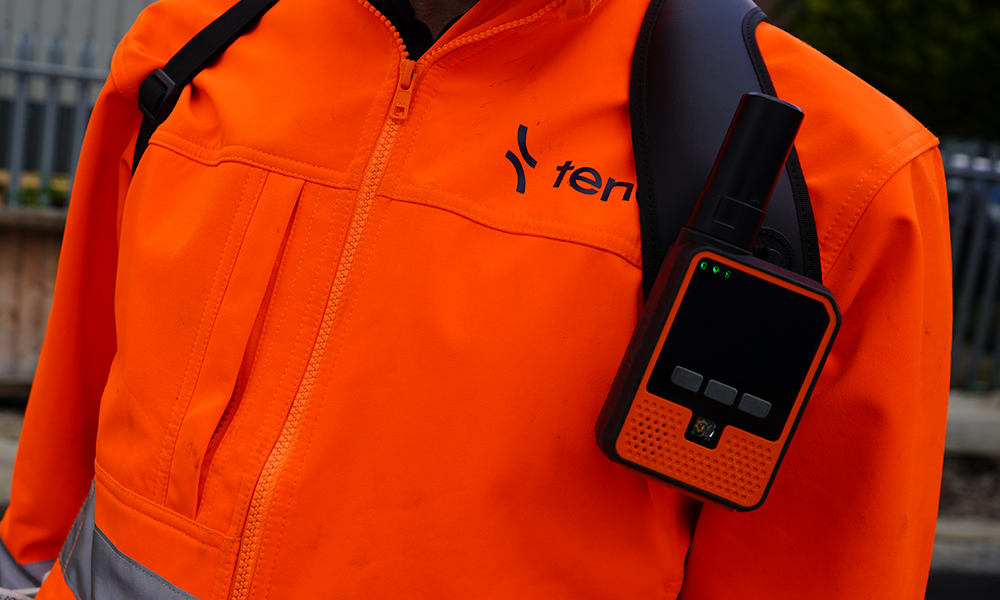
Geofencing can be used to create virtual boundaries around defined safe working areas. When workers cross over that boundary, a small geofencing device alerts them instantly, notifying them to correct their position before they potentially put themselves in an unsafe position.
This is particularly critical in line blocks or works with adjacent open lines, where the consequences of straying outside safe limits can be serious. Rather than relying solely on verbal/written communication or a worker's own awareness, geofencing provides teams with real-time safety alerts if they stray outside of the worksite. Similarly, if a worksite is stopped for handback and anyone remains on the line, the device alerts them to move to a position of safety, helping to remove ambiguity around open lines.
Learn more about how geofencing can help reduce the risk of near misses on the railway
Reducing the risk of incorrect or unsafe access points being used
Safe access to infrastructure is essential for mitigating incidents and maintaining operational efficiency. However, incorrect or unsafe access, whether through unauthorised locations or before a possession has been taken, remains a recurring safety issue across the industry.
Geofencing helps reduce the risk of this by mapping out approved access and egress points as part of a digital worksite. When workers enter a site at the correct location, their geofencing device confirms it. If they attempt to access from the wrong point, or arrive before a possession or line block has been taken, they're alerted. This helps remove the reliance on verbal communications and paper-based systems, giving workers and supervisors additional reassurance around correct access points.
Learn more about how geofencing can reduce the risk of incorrect or unsafe access points being use
Supporting safe and efficient possession management with Virtual Worksite Marker Boards
The way worksites are physically defined has long relied on manual processes, requiring workers to access the line, interpret paper plans, and communicate verbally to confirm correct placement. Each of these steps introduces the potential for human error and in tight possession windows, errors carry real consequences.
Virtual Worksite Marker Boards (VWSMBs) replace this process with a digital, geofenced alternative. Worksite limits are mapped in minutes on an online dashboard, and on-track plant is equipped with in-cab positioning devices that alert drivers as they approach the geofence boundary. There is no need for workers to go on track to place or retrieve boards, no risk of incorrect placement, and no boards left behind at the end of a shift.
The benefits extend beyond safety. By removing the manual steps involved in board placement and retrieval, VWSMBs free up valuable time within the possession window. For Engineering Supervisors, real-time visibility of worksite limits also reduces the volume of coordination calls needed to manage the possession effectively.
Learn more about how VWSMBs are transforming possession management
Come see us at Rail Live to learn more
Taking place during Rail Safety Week 2026, Rail Live is the perfect opportunity to engage in conversations around safety, and how technology such as geofencing is driving real change across the industry.
Tended will be exhibiting at Rail Live on stand B17. As geofencing continues to gain momentum across the rail industry, we’ll be showing how digital worksite management can help teams improve visibility, reduce risk, and operate more efficiently, all while helping frontline staff stay safer on and around the railway.
Come and speak to our geofencing experts to discover how Tended is helping Network Rail routes and regions, and principal contractors modernise the way worksites are planned and safely managed. With 200+ suppliers, 7,000+ attendees, and hands-on demos across two packed days, Rail LIVE is set to be a fantastic opportunity to connect, learn, and explore the future of rail innovation.


