
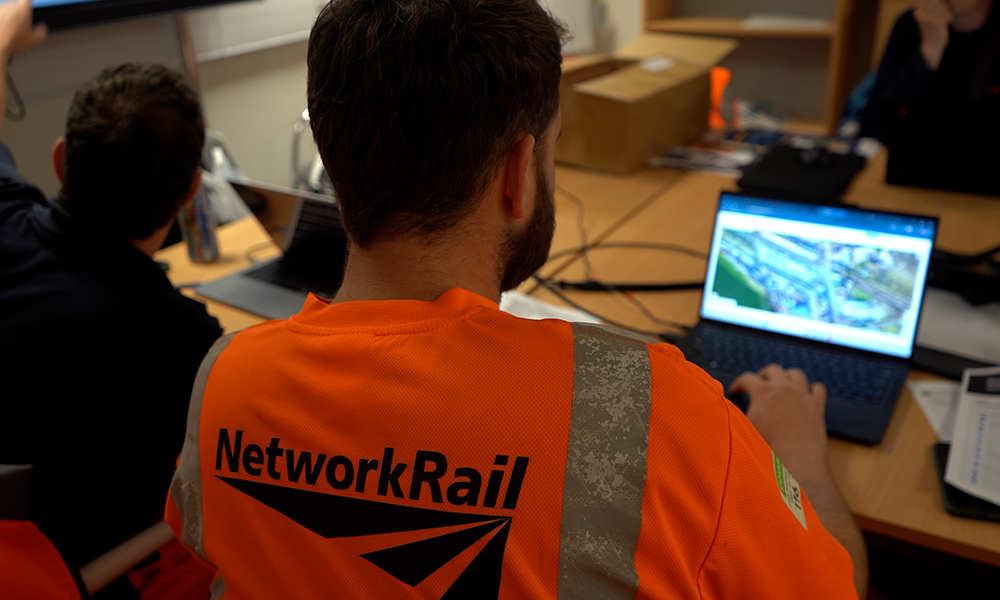


Our customer spotlight series places a focus firmly on our clients and partners leveraging Tended's geofencing technology and the inspiring work they're doing to improve safety on our railways.
Over the past few years Tended has worked with Network Rail Wales and Borders to deploy geofencing technology as part of a staged rollout.
The first in the UK to rollout geofencing route-wide, Wales and Borders was an early adopter of geofencing, initially piloting Tended’s system back in February 2023 shortly after the technology was approved for use on the railway.
Since then, the route has been an ongoing champion of the system and in March 2025, Wales and Borders took a major step forward in the advancement of workforce safety by committing to deploying Tended’s geofencing technology for all maintenance teams.
From safety wearables to full worksite visibility and possession management
Stage one of the rollout began with Tended’s wearable safety devices, which Wales and Borders deployed with its trackside teams to help enhance situational awareness and help them maintain a safe distance from open lines. Wearable devices also confirm to teams that they are at the correct access point and alert them if they exit the safe work zone.
Following this application, the second stage introduced asset tagging, which involves attaching devices to assets such as possession limit boards (PLBs) and Worksite Marker Boards (WSMBs). When assigned as assets, Tended's devices provide a live location, helping to verify that protection equipment is placed in the correct location on site and retrieved before handback.
The third stage expanded into tagging mobile assets such as trolleys and on-track plant (OTP). This helps to keep the assets in the right location and prevents worksites being handed back with items still on the line. It also gives the Engineering Supervisor (ES) greater visibility of onsite operations and the location and movement of assets..
Katie Nicholson, Project Manager for the Safe and Effective Working Team at Network Rail Wales and Borders reflected on the journey with Tended so far: “Over the last 5 years, we’ve had 66 incidents that could potentially have been prevented if geofencing was fully implemented and adopted. 15 of those were in the last year. Every time we see an incident, we think - could we have used geofencing to have kept that from happening? And what can we look at to start to implement that? I also do think that it's starting to change the way people think about the way they're working.”
Now: Virtual Worksite Marker Boards
The groundwork put in since the initial geofencing deployment has now led to the successful introduction of Virtual Worksite Marker Boards (VWSMBs). This system uses geofencing in place of physical boards, and in-cab devices alert the operators of OTP when they approach worksite limits. Not only does this come with significant efficiency gains, it also completely removes the need for teams to access the infrastructure to place boards, eliminating the risk of incorrect marker board placement as well as removing the risk of teams being exposed to open lines.

Outcomes of the initial deployment
By replacing physical boards with VWSMBs, Whitland P-Way teams have:
- Removed the need for staff to go on track to place and collect boards, eliminating any associated safety risk
- Gained 40 minutes of productive time per shift
- Taken 3 vehicles off the road for board placement, saving 40 miles of travel per shift
- Removed the need for 6 phone calls per shift between team members
Across all 8 shifts conducted as part of the initial deployment, that's:
- 5 hours 20 minutes of productive time gained
- 320 miles of vehicle travel avoided
- 24 vehicle journeys removed
- 48 phone calls removed
- 8 shifts with no staff going on track to place or collect boards
Engineering Supervisor Jack Parsons noted the safety benefit of removing that need to go out onto the track to confirm location: "You are not going out there and potentially going on the wrong track, which to me is priceless, really."
Charlie French, Section Supervisor for Wales and Borders, described the impact for teams working on the route: "At the start of a possession, the ES might need to arrange multiple boards. In our section, that could be up to six boards, and it could take teams on site 20 to 30 minutes to set up. With the virtual worksite marker board, the ES does it at the click of a button, and it's done instantly. That's potentially an hour extra to do the work."
Before virtual marker boards, locating a worksite could involve multiple phone calls and physically walking the mileage to confirm position, particularly challenging for teams less familiar with an area, or when a site looks different at night compared to during the day.
Wales and Borders has worked closely with trade unions throughout this deployment journey to make sure help ensure the rollout reflected the needs and concerns of the teams using it on the ground. Tended looks forward to continuing to roll out geofencing across the route, with VWSMBs being deployed with further projects over the coming months.


