
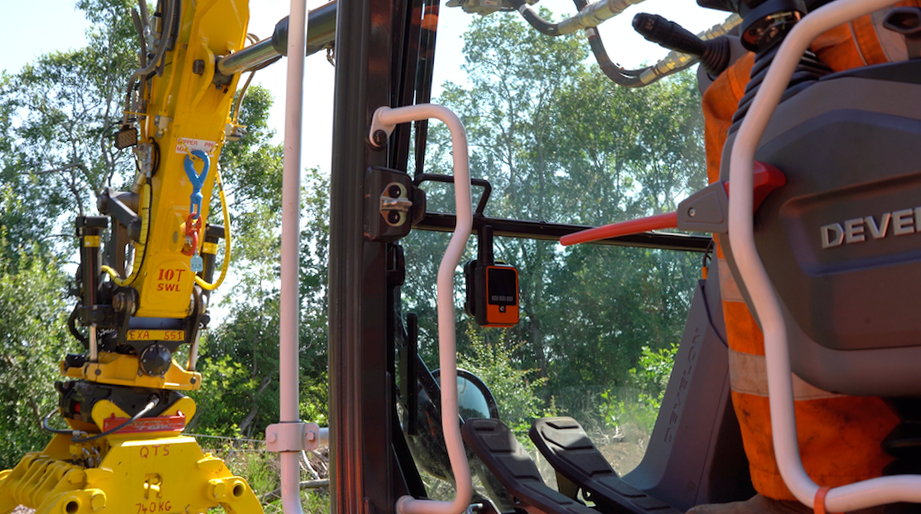
Between August 2025 and October 2026, Virtual Worksite Marker Boards (WSMBs) have been used on over 250 shifts for worksites across Network Rail routes and Principal Contractors. Those shifts are now giving a clear picture of the tangible impact of replacing physical WSMBs with digital limits, including significant time saved and fewer people needing to go out on track.
The challenges with physical boards
Physical WSMBs mark worksite limits for On-Track Plant (OTP), On-Track Machines (OTM) and Engineering Trains. They are well established, but come with several challenges.
For example, placing and recovering boards may require track workers to walk close to open lines, often in low light or poor weather, exposing them to potential risks.
Manual placement also leaves room for human error. Boards can be positioned incorrectly or left on the line after works. This creates uncertainty over the true worksite limits, increases the risk of unsafe movements onto open lines, and can mean services are held so that boards can be recovered.
Additionally, placing and recovering boards takes time at the start and end of every possession. With possession time limited, this time spent setting up and handing back a worksite is time not spent on the work itself.
How Virtual WSMBs work
Virtual WSMBs use geofencing to mark out worksite limits digitally. Instead of a physical board at the limit, a device in the cab of OTP onsite gives the operator an audible and visual alert as they approach the worksite limits. The Engineering Supervisor (ES) can then see the position of OTP on an online Dashboard.
The system was developed by Tended with Network Rail's Technical Authority, and a national deviation for OTP-only possessions across Scotland, England and Wales was granted in 2025.
Results to date
Across more than 250 shifts, Tended’s system applied for Virtual WSMBs has delivered:
177 hours of possession time saved
10,350 vehicle miles avoided
3,052 phone calls removed
662 workers deployed to other tasks
Such time savings are significant in the railway industry, where every minute counts. More productive time means that work can get done quicker, reducing the risk of any costly handback delays and minimising the disruption to journeys.
The phone calls removed would otherwise have taken up the ES’s time during set-up and handback. The 10,350 miles avoided reflect vehicle journeys no longer needed to reach board locations, which also reduces logistical complexity and carbon emissions.
Based on the significant time savings and other benefits from Virtual WSMBs, we can infer significant cost savings for the rail industry. Based on average possession costs, we estimate this to be in the hundreds of thousands so far.
Deployment examples
Organisations including Siemens Mobility, Network Rail Wales & Borders, Network Rail East Coast, Network Rail Scotland and SPL Powerlines UK have moved from initial trials to continued use on their OTP-only worksites. Their deployments range from routine maintenance shifts to a 30+ mile worksite on the East Coast Main Line and a possession delivered with no physical boards of any kind.
Next steps
The national deviation currently covers OTP-only possessions, and work to extend it to OTM and Engineering Trains began in 2026. As more virtual worksites are run, the time and cost savings will continue to build.
To discuss Virtual WSMBs for your worksites, contact the Tended team at info@tended.co.uk.